
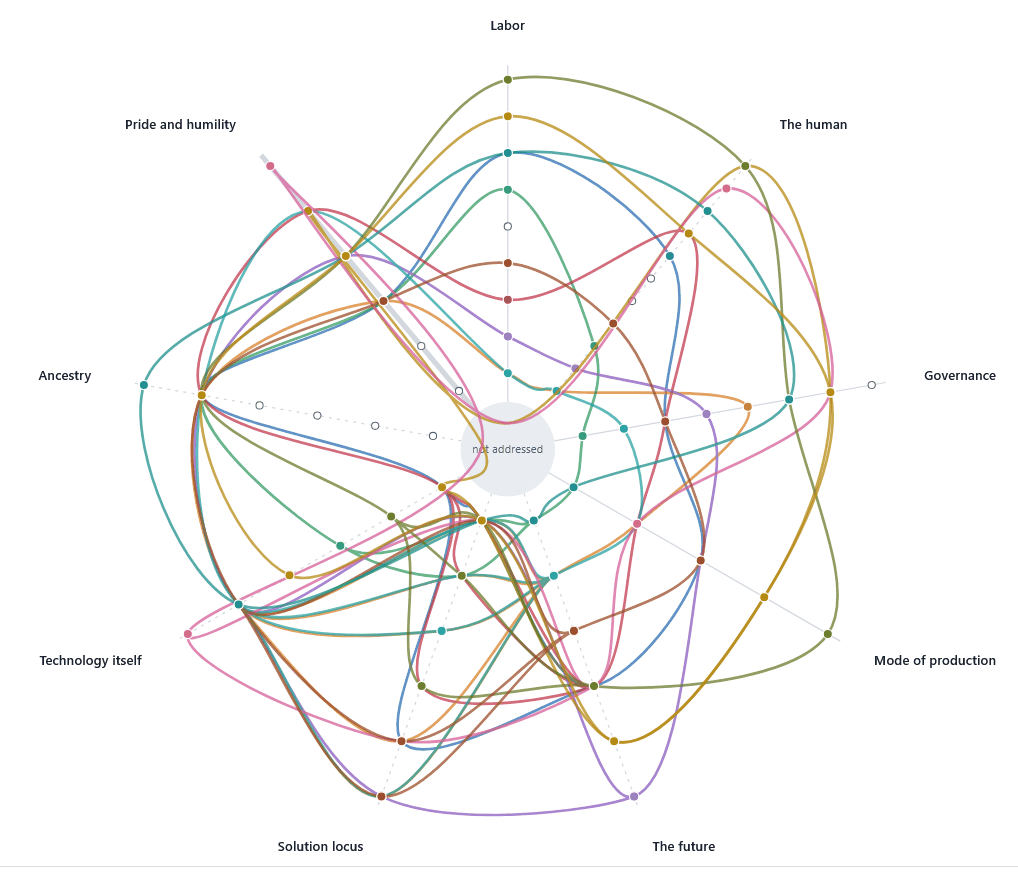
The first AI and Work graph showed who says what about AI and work, week by week. It was accurate and it was dense: readers outside the field saw a tangle. This post introduces a second instrument with a different job. Instead of tracking the conversation, it reads the visions themselves: the manifestos, statements, plans and encyclicals in which companies, states, churches and critics say what AI will do to work and what should be done about it.
Open the interactive page full screen →
What the wheel shows
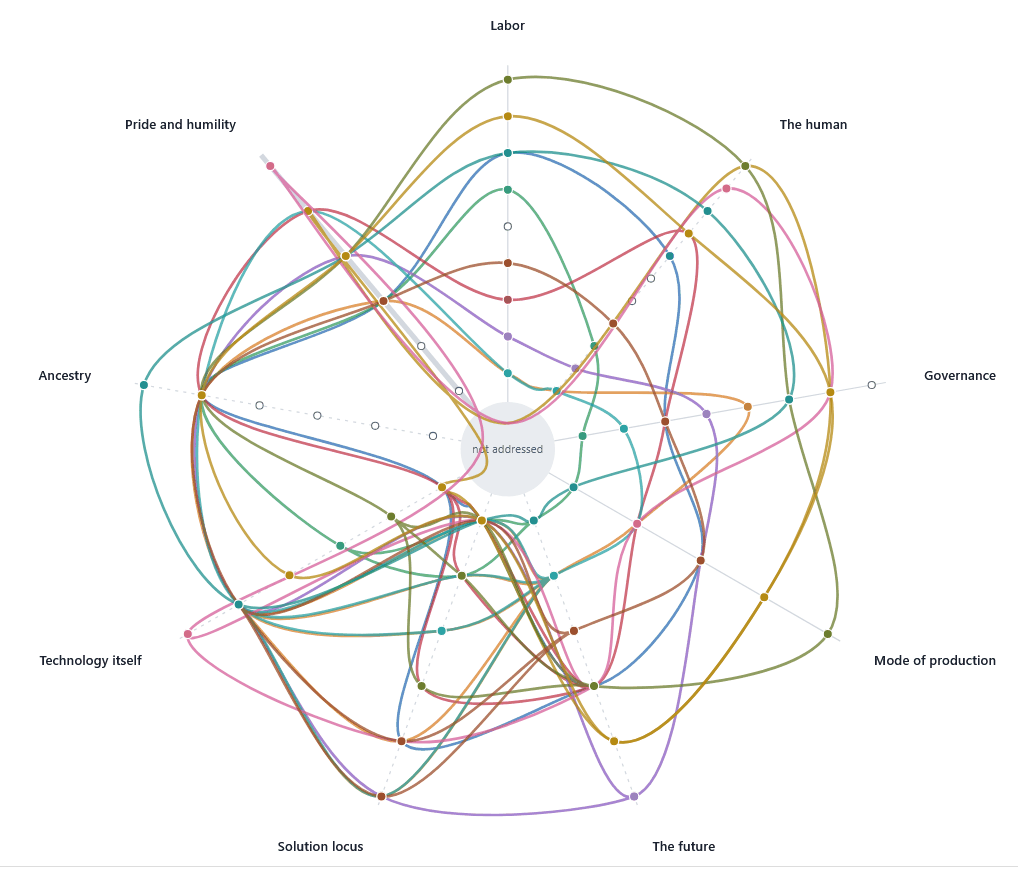
The wheel has nine spokes. Each spoke is one question the study asks of every text:
1. **Work:** why does work matter?
2. **The human:** what is the human’s role alongside AI?
3. **Governance:** who decides about AI?
4. **The economy:** what economic system does the text want?
5. **The future:** what shape does the future take?
6. **The remedy:** where does the solution act: in people’s choices, in institutions, in the spirit, in the machine?
7. **Technology:** what is AI, a tool, a worker, a being with its own aims?
8. **Ancestry:** which older story does the text tell, and how?
9. **Pride and humility:** how does the benefit move between people, from taking to giving?
Each text is one line around the wheel, passing through its answer on every spoke. Where a text gives more than one answer, its line splits. Two texts with the same shape share a vision, whatever they call themselves.
How to read it
Every text is read twice. The **described** reading is what the text says the world is, or is heading toward. The **advocated** reading is what it argues should happen. A text can describe one world and fight for another, and the gap between the two is often the point of the text.
**Compare mode** sets one text’s described world against another’s advocated vision. It shows who is arguing against whom, even when neither names the other.
Hover a spoke to see its question and answers. Pick a text to see its quotes: every answer on the wheel rests on a sentence from the text itself.
What the first twelve texts show
These come from the first coding run on twelve texts. They are provisional: the coding guide was revised after this run, and the next run adds more texts.
**Who decides now.** Three texts from very different places describe the same thing: a few private actors deciding about AI in practice, above or around governments. *The Intelligence Curse* expects control “concentrated in the hands of a few players: the labs that produce AI, the states where they reside, and the companies that manufacture the raw materials, the chips, and the robots, and the electricity they all need.” Pope Leo XIV’s *Magnifica Humanitas* finds “the main drivers of development are private, often transnational, parties” with capacities “that surpass those of many Governments.” A chapter in *Feminist AI* says machine learning systems are “centralised and monopolised largely by racial capitalists,” while “billions of racialised people across the world have no say.” A secular policy essay, a papal encyclical and a critical scholar agree on the description. They part on the remedy: democratized institutions, layered responsibility from communities up to international bodies, power distributed “between developers and users.”
**What takes the place of work.** The texts agree that AI changes work; they disagree on what fills the time it leaves. Dario Amodei, Anthropic’s chief executive, welcomes it: “people also greatly enjoy activities that produce no economic value.” The Southern Baptist Convention’s ethics body warns against it: humanity “should not use AI and other technological innovations as a reason to move toward lives of pure leisure.” *Magnifica Humanitas* fears the version that is not chosen: a society that employs only a few “risks exposing many to forced inactivity.” Same question, three attitudes: welcomed, rejected, feared.
How the answers were made
The answers on the wheel were coded by an AI model, Claude, made by Anthropic. Anthropic’s chief executive wrote one of the texts coded here, so the coder has a stake in at least one result. Readers should weigh that, and the quotes are there so they can.
Every code had to pass checks written as a script. Each answer must rest on a quote, and the script confirms that the quote appears word for word in the source. Categories come from a codebook built from the texts themselves, with plain definitions anyone can apply. Before this run, the categories were calibrated: I and the model coded the same texts separately, with the model’s answers sealed before I started, then we compared and settled the definitions.
The ninth spoke, pride and humility, applies a standard I disclose: my own approach to ethics, grounded in my faith, with its definitions published. Other readers would draw that spoke differently, which is why the standard is stated openly.
What comes next
The next run adds texts the first one left out: AI company leaders (OpenAI, Meta, Microsoft, Amazon, Tesla, Palantir), national intelligence and security services, the Church of Jesus Christ of Latter-day Saints, and Jewish, Islamic and Buddhist responses. The wheel will grow from twelve lines to about thirty-five. The question that interests me most: when the companies building AI, the agencies deploying it and the faith traditions judging it describe the same world, do they want the same one?