
Part 1: 34 visions of our future with AI, and the people and institutions who wrote them
Change is coming faster than any of us can absorb, and the anxiety it brings calls for a vision: a plan for who we become as our assumptions about ourselves shift beneath us.
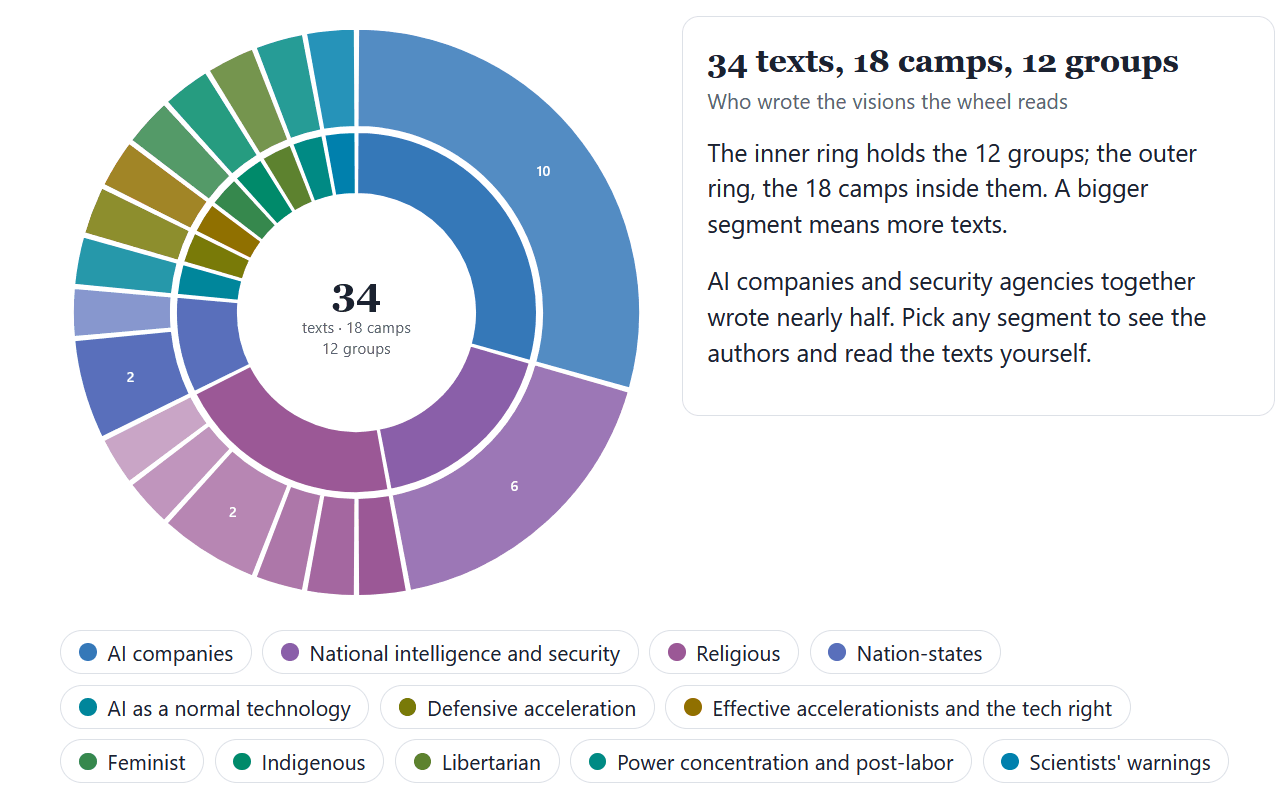
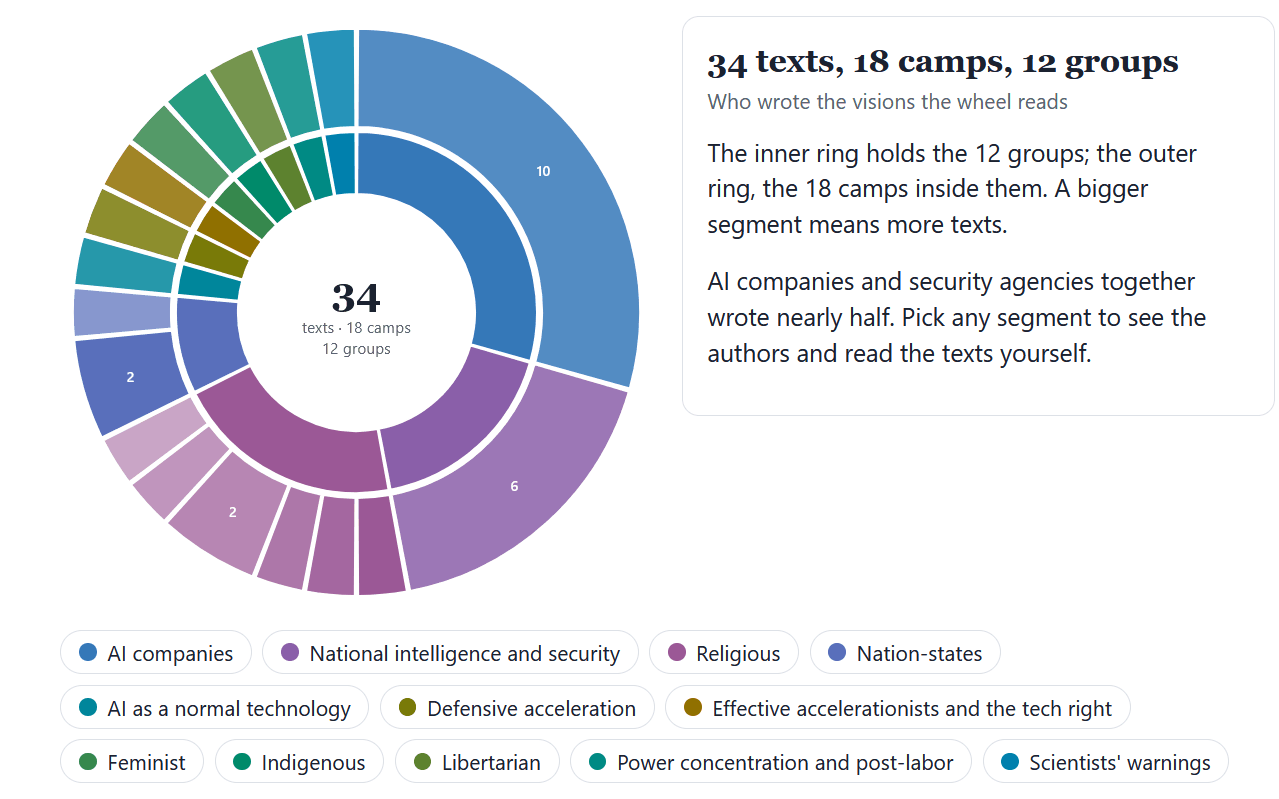
teKnoculture’s AI and Work series studies these visions of the future: 34 texts by 26 people and 12 institutions. Each one is on the Visionary Wheel below, with who wrote it and where to read it yourself.
Open the interactive page full screen →
We, as a human family, are impacted so knowing possible strategies, discussing and choosing them is my goal. A reader can see everything, read and judge what we found, and also tell us what we missed.
What this Visionary Wheel is, and what it is not
The wheel reads published visions: manifestos, essays, government plans, security directives, papal and denominational statements. These are texts in which an author or an institution says outright what AI will do to work and what should be done about it. The study calls this the declared layer.
The Visionary Wheel asks every text nine questions, one per spoke:
- Work itself: Why does work matter?
- The human: What is the human’s role with AI?
- Governance: Who decides about AI?
- Economic system: What economic system does the text want?
- The future: What shape does the future take?
- Where the fix lies: Where does the remedy act?
- Technology itself: What is AI?
- Influences: What older idea or movement does the text continue?
- Pride and humility: How does benefit move between people?
To see how every text answers them, open the full Visionary Wheel.
Preliminary work looked at what people say about AI and work online: Who is talking about AI and work, in whose words. That graph is preliminary and will be revised, with clearer instructions on how to read it. The study plans these layers:
- What people say: social media posts about AI and work.
- What people ask: questions people type when no one is watching.
- What people do with the visions: how a vision is taken up, adapted, mocked or acted on.
- What it is like to live through it: the researcher’s own record of working with AI.
Every layer is coded with the same questions, so the layers can be compared: where the people who publish visions and the people who live with them agree, and where they part. This post covers the first layer only. A later article will detail these asked questions.
The 34 texts, by camp
| Group | Camps | Texts |
|---|---|---|
| AI companies | 1 | 10 |
| National intelligence and security | 1 | 6 |
| Religious | 6: Buddhist, Catholic, Evangelical, Islamic, Jewish, Latter-day Saints | 7 |
| Nation-states | 2: Chinese state, US state | 3 |
| Eight groups of one camp each | 8: AI as a normal technology; defensive acceleration; effective accelerationists and the tech right; feminist; Indigenous; libertarian; power concentration and post-labor; scientists’ warnings | 8 |
| Total | 18 | 34 |
The authors are about 26 named people and about 12 institutions, and the two overlap: a pope speaks for the Catholic Church, an apostle for the Latter-day Saints, a rabbi through his movement’s law committee.
AI companies (10)
- Dario Amodei (Anthropic), Machines of Loving Grace (2024)
- Sam Altman (OpenAI), Moore’s Law for Everything (2021)
- Sam Altman, The Intelligence Age (2024)
- Sam Altman, Three Observations (2025)
- Mark Zuckerberg (Meta), Personal Superintelligence (2025)
- Mustafa Suleyman (Microsoft AI), Towards Humanist Superintelligence (2025)
- Andy Jassy (Amazon), memo to employees on generative AI (2025)
- Tesla, Master Plan Part IV (2025)
- Alexander C. Karp and Nicholas W. Zamiska (Palantir), The Technological Republic (2025), publisher’s sample
- Leopold Aschenbrenner, Situational Awareness (2024), selected chapters
National intelligence and security (6)
- Office of the Director of National Intelligence (US), Principles of AI Ethics and AI Ethics Framework for the Intelligence Community (2020). The intelligence community’s website now titles both “Super Intelligence,” following the September 29, 2026 executive order that tells federal agencies to use that term in place of “AI”; the 2020 originals still say “Artificial Intelligence” (accessed October 14, 2026).
- ODNI, Intelligence Community Directive 505, Artificial Intelligence (2025)
- GCHQ (UK), Pioneering a New National Security: The Ethics of AI (2021); GCHQ’s AI page (the original PDF link is gone)
- NSA and Five Eyes partners, Deploying AI Systems Securely (2024); NSA announcement
- The White House, Framework to Advance AI Governance and Risk Management in National Security (NSM-25 companion, 2024), ACLU of Massachusetts copy. The intelligence community’s website still lists it, as “Framework to Advance SI Governance and Risk Management in National Security,” but ai.gov, where it was published, now redirects to si.gov, and the document is no longer on a government site (accessed October 14, 2026).
- The White House, NSPM-11, Artificial Intelligence in the National Security Enterprise (2026)
Religious (7)
- Buddhist: Mind and Life Institute, Dialogue XXXIX with the Dalai Lama (2025), news report
- Catholic: Pope Leo XIV, Magnifica Humanitas (2026)
- Evangelical: Southern Baptist Convention, resolution on AI and emerging technologies (2023), with the ERLC’s Evangelical Statement of Principles (2019)
- Islamic: IslamQA, fatwa 540774 (2025); IslamWeb, fatwa 211585 (2013)
- Jewish: Rabbi Daniel Nevins, Artificial Intelligence, Moral Machines and Halakha, responsum for the Committee on Jewish Law and Standards (2019)
- Latter-day Saints: The Church of Jesus Christ of Latter-day Saints, newsroom guidance (2025 to 2026), including Elder Gong’s Athens speech
Nation-states (3)
- Chinese state: Ministry of Foreign Affairs, Global AI Governance Action Plan (2025); State Council, AI+ Opinions (2025), CSET translation
- US state: The White House, America’s AI Action Plan (2025)
One text each (8)
- AI as a normal technology: Arvind Narayanan and Sayash Kapoor, AI as Normal Technology (2025)
- Defensive acceleration: Vitalik Buterin, My techno-optimism (2023)
- Effective accelerationists and the tech right: Marc Andreessen, The Techno-Optimist Manifesto (2023)
- Feminist: Feminist AI (Oxford, 2023), chapters by Lelia Marie Hampton, Neda Atanasoski and Jennifer Rhee
- Indigenous: Jason Edward Lewis, Hēmi Whaanga and Ceyda Yolgörmez, Abundant Intelligences (2025)
- Libertarian: Peter Thiel, The Education of a Libertarian (2009)
- Power concentration and post-labor: Luke Drago and Rudolf Laine, The Intelligence Curse (2025), selected chapters
- Scientists’ warnings: Geoffrey Hinton, interview in Time (2025) and Nobel banquet speech (2024)
Who is missing
Three things about this list matter for reading the wheel.
Companies and security agencies wrote nearly half of it. AI companies wrote 10 of the 34 texts, and national security agencies 6 more.
Eight camps rest on a single text. For those, one author stands for a whole position: Andreessen for the accelerationists, Thiel for the libertarians, Hinton for the scientists who warn.
Almost every voice speaks from a center of power. Feminist and Indigenous authors write from outside those centers; the rest are chief executives, states, religious authorities and established researchers. Additionally, workers appear only as others describe them. That is the nature of the declared layer, since the people who publish visions are mostly people with platforms. It is also why the study has other layers: workers’ own words belong to what people say, ask and do.
How the texts were chosen
Having researched data science for 16 years, and having used image generators and large language models in my business, I select visionary texts seeking to be inclusive since we all are or will be impacted by AI. Additionally, these visionary texts articulate the relationships between AI technology, human interaction and impact (usually in the form of work), and our social/societal structures.
Some texts were analyzed only in part: the publisher’s sample of The Technological Republic, selected chapters of Situational Awareness and The Intelligence Curse, and three chapters of Feminist AI. The Chinese texts were read in English (the Ministry’s own English version; CSET’s translation). The list will change: each new run adds texts, and this post will be updated with a dated note when it does.
How the texts are analyzed
Each text was coded by an Anthropic AI model, Claude, against a codebook the author designed with the coding model and calibrated against his own blind coding, then checked by the author; every answer rests on a quote that a script confirms word for word in the source. Full disclosure: Anthropic’s chief executive wrote one of the texts above, so the coding LLM has a stake in at least one result. I plan to release our full methodology later because my lived experience as a researcher includes Large Language Models (“AI”).