
Part 2: the questions behind the Visionary Wheel spokes
When someone says AI will change work, two questions follow: change it how, and who gets to decide? A company memo, a Vatican encyclical and an intelligence community directive don’t interpret that change the same way, and they don’t use the same words for it.
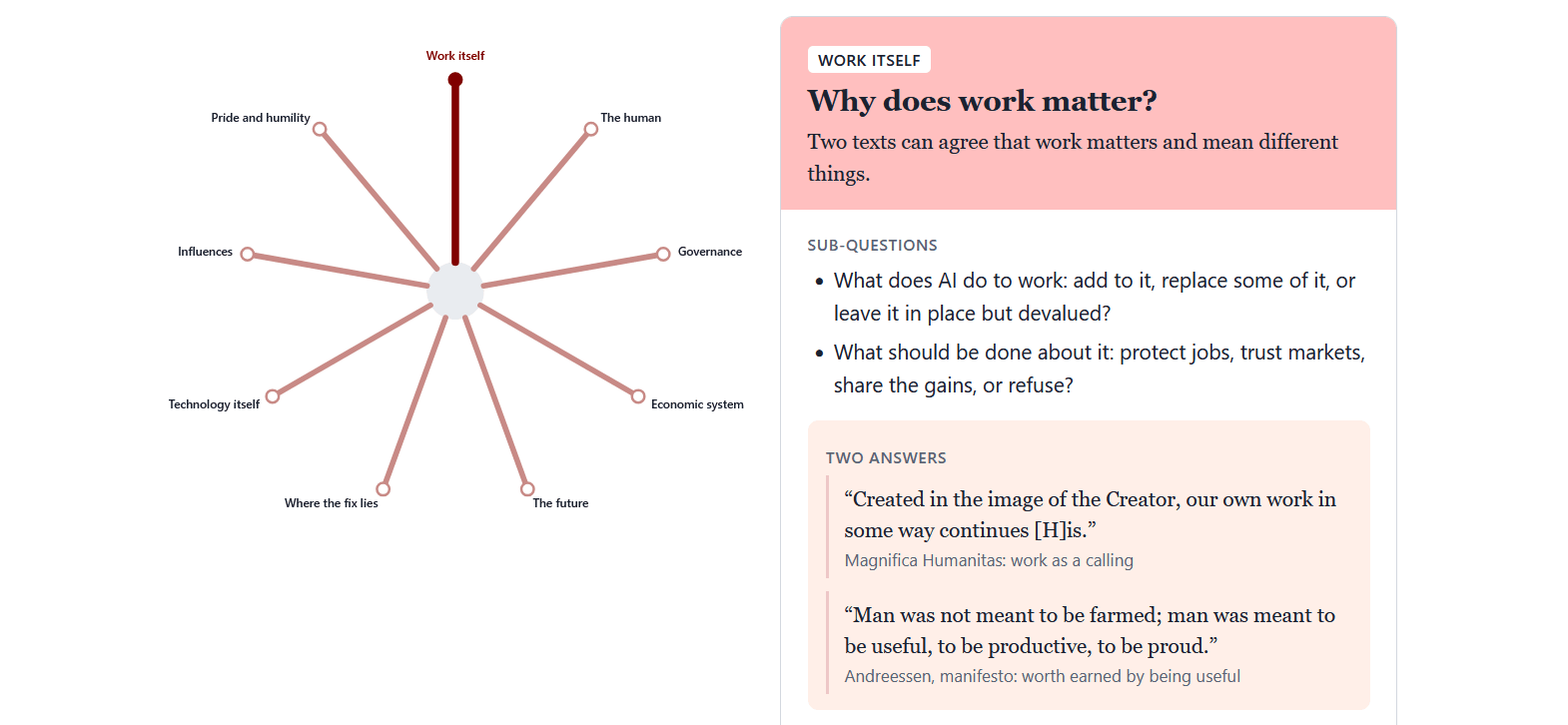
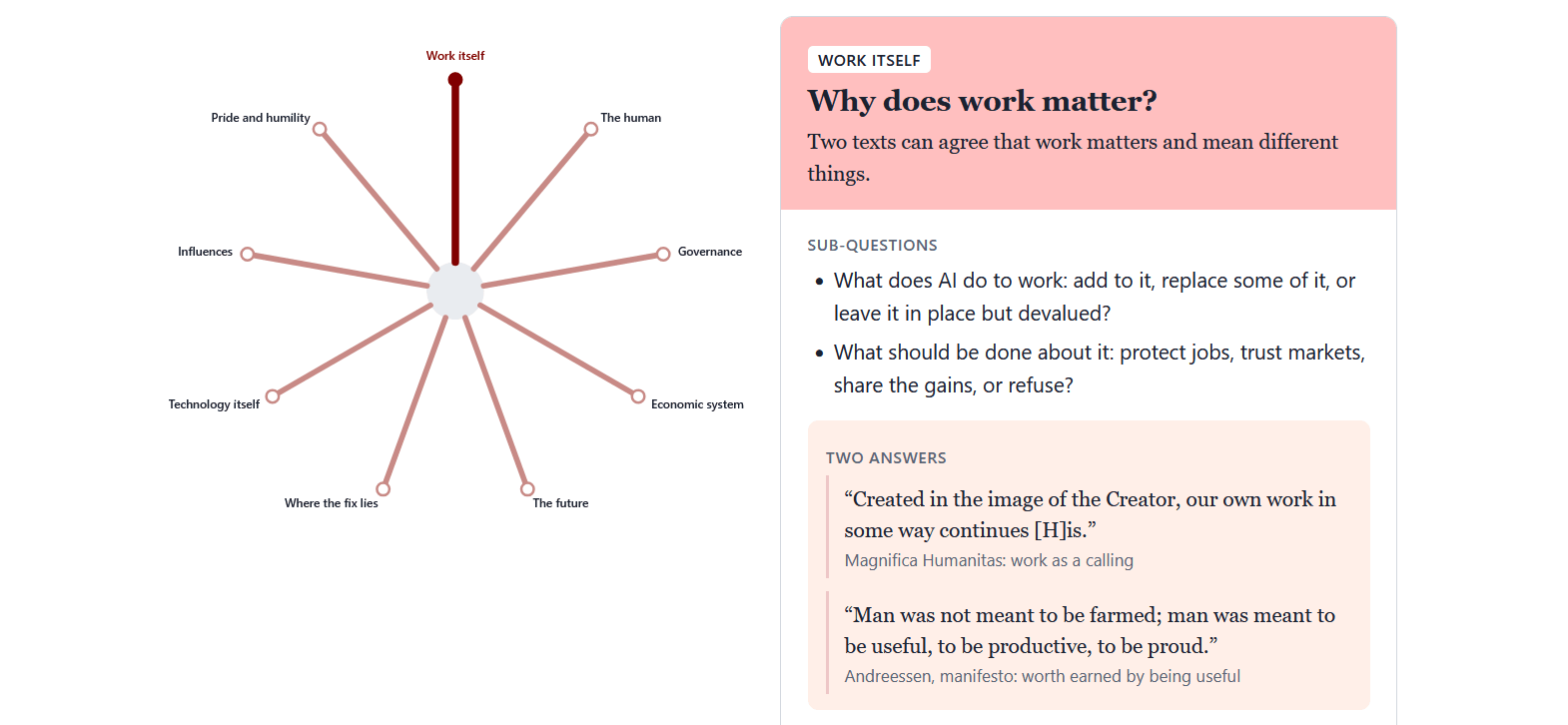
To compare them evenly, we ask all 34 texts the same nine questions. The Visionary Wheel records the answers, one spoke per question. This post takes each question in turn and pairs it with a contrast between two texts. Work itself serves as the worked example of how an answer is coded into a category.
Open the interactive page full screen →
We chose these nine questions to capture how each vision imagines AI reshaping people, their work, and society, from the economy to governance.
The nine questions, with their sub-questions and one contrast each
Asking every text the same questions lets us sort their answers into categories (called codes in qualitative content analysis) and compare one text with another. When asked what a good outcome with AI looks like, for example, a company might say “abundance,” a church “dignity,” and an intelligence agency (GCHQ) “responsible use.”
Each coded answer names its category and quotes the text exactly, with a citation to where the passage appears. It also records how confident the coding is and flags any placement that rests on judgment. When a text never addresses a question, we code it “not addressed,” and that absence is itself a finding. Coding was done by an LLM using a fixed codebook we designed, and a human reviewed every flagged judgment call.
Each question also breaks into sub-questions that capture finer distinctions, coded separately, and with its own quotations. We also track these two distinctions across all nine questions:
• Description versus advocacy. Many texts say one thing about how things are now and another about how they should be. We code the two separately.
• Position versus reason. Two texts can take the same position for opposite reasons, so we code the reason separately.
With that framework in place, the nine questions below show where the visions start to pull apart and things get interesting.
Work itself: Why does work matter?
• What does AI do to work: add to it, replace some of it, or leave it in place but devalued?
• What should be done about it: protect jobs, trust markets, share the gains, or refuse?
Two texts can agree that work matters but have totally different meanings. Magnifica Humanitas says “Created in the image of the Creator, our own work in some way continues [H]is.” That is work as a calling. Andreessen’s manifesto says “Man was not meant to be farmed; man was meant to be useful, to be productive, to be proud.” That is worth earned by being useful.
How the two “Work itself” answers are coded:
Magnifica Humanitas
• Why work matters: dignity (a calling)
• What AI does to work: partial replacement
• Who loses: young people entering work, data workers and ordinary workers
• What should be done: keep people working, share the gains and augment
Andreessen’s manifesto
• Why work matters: usefulness (worth earned)
• What AI does to work: growth
• Who loses: no one
• What should be done: trust markets and augment
They differ on four lines and agree on one: both want tools that augment people.
On the Visionary Wheel, the Work itself spoke shows where all 34 texts answer this question.
The human: What is the human’s role with AI?
• Should/can/will humans be changed: kept as given (natural), enhanced, or merged with machines?
• Why that role: given by God, held by power, or kept for safety?
GCHQ describes people as users the software supports: AI will “flag significant conclusions for review by a human analyst.” Magnifica Humanitas describes humans as a steward, so that “it will always be human intelligence, with its conscience and freedom, that guides technical innovations and responsibly determines their use.”
On the Visionary Wheel, the human spoke shows where all 34 texts answer this question.
Governance: Who decides about AI?
• Who decides now, and who should: companies, governments, markets, communities, or no one?
• By what form of rule: markets, democracy, rights-bounded government, or whoever holds the power?
Both Magnifica Humanitas and Andreessen’s manifesto favor decentralizing control but for opposite reasons. The encyclical says “decisions are made at the closest level possible to the persons involved,” and warns of private concentration and technocracy. Andreessen’s manifesto says “We believe free markets are the most effective way to organize a technological economy,” and names the state and experts as the danger. One direction, two diagnoses.
On the Visionary Wheel, the Governance spoke shows where all 34 texts answer this question.
Economic system: What economic system does the text want?
• What economy does the text see now, and what economy does it want?
• Why that future system: growth, the common good, a moral duty, or ordinary people’s bargaining power?
China’s State Council plan for “AI+” calls for state-led development: “Persist in implementing the Party’s leadership throughout the course of the ‘AI+’ initiative.” Narayanan and Kapoor, in AI as Normal Technology, lean on markets with limits: “In many cases, market forces will provide an adequate incentive, but safety regulation should fill any gaps.”
On the Visionary Wheel, the Economic system spoke shows where all 34 texts answer this question.
The future: What shape does the future take?
• What does the text fear: disempowerment, loss of control, or a bad order made permanent?
• Whom does it blame: elites, human pride, bad actors, or structures with no single culprit?
Tesla’s Master Plan Part IV says, “Growth is infinite.” Geoffrey Hinton’s Nobel banquet speech makes the future conditional: “If the benefits of the increased productivity can be shared equally it will be a wonderful advance for all humanity.”
On the Visionary Wheel, the The future spoke shows where all 34 texts answer this question.
Where the fix lies: Where does the remedy act?
• Where does the remedy act: in the will, in institutions and tools, in community, or in the machine’s own motives?
• Should AI reach into the inner life: welcomed, limited, or feared?
Some texts place the remedy in people’s will, some in institutions and tools, some in community or in the machine’s own motives. A related code asks whether AI should reach into the inner life. Zuckerberg welcomes it: “Personal superintelligence that knows us deeply, understands our goals, and can help us achieve them will be by far the most useful.” Magnifica Humanitas fears it: platforms “exploiting their vulnerabilities and weakening their inner freedom.”
On the Visionary Wheel, the Where the fix lies spoke shows where all 34 texts answer this question.
Technology itself: What is AI?
• Can technology save, and from what: scarcity, disease and death, or nothing?
• Can it be steered: by choosing what to build, by communities, by the state, or not at all?
Is AI a tool or a worker? The Intelligence Curse says “Tools like hammers and computers make humans more effective at their work.” Altman’s “Moore’s Law for Everything” describes labor whose price “will fall toward zero once sufficiently powerful AI ‘joins the workforce.’”
Sub-questions (2 of 3):
On the Visionary Wheel, the Technology itself spoke shows where all 34 texts answer this question.
Influences: What older idea or movement does the text continue?
• What past episode does the text use as an analogy: an industrial revolution, the frontier, empire, or the Cold War?
• How is the older story told: as a triumph, a warning, a wound, a promise, or a model?
Rabbi Daniel Nevins’s responsum on AI begins from scripture: “Beginning with the Torah (Exodus 21:25-36 and 22:4-5) Jewish law holds owners responsible for damage caused by their property.” A chapter in Feminist AI names a modern line, the Black feminist Marxism of Claudia Jones: “From the Jones theoretical view, hardware as a means of production for AI creates a system of domination.”
On the Visionary Wheel, the Influences spoke shows where all 34 texts answer this question.
Pride and humility: How does benefit move between people?
• Who ends up with the benefit: the few, the few while the text claims it reaches all, or everyone?
• Does it rank some humans above others, hold all of equal worth, or oppose such ranking?
This question applies a standard of mine, which I state openly wherever these codes are used. One code asks whether a text gives technology what religions reserve for God, such as knowing everything or holding all power. Hinton writes that large AI systems “already know thousands of times as much as any one person.” Aschenbrenner writes that superintelligence “will be the most powerful technology” mankind has ever developed.
On the Visionary Wheel, the Pride and humility spoke shows where all 34 texts answer this question.
What this cannot tell you
• It reads what texts say. It does not test whether they are right. This is the declared layer: what authors and institutions say they want.
• The categories are drafted, and the definitions are marked draft in the coding guide. They change when a calibration round shows a disagreement.
• An AI model does the first coding, and a script checks every quotation against the source. That shows each quote exists. It does not show the quote was read correctly, which is why we also code a sample blind and review the flagged answers. Of 3,309 coded answers so far, 534 are marked low-confidence for that review.
• Thirty-four texts are a chosen set. Companies and intelligence agencies wrote nearly half of them, and workers appear only as others describe them.
• The nine questions are mine as a set. Each is familiar from fields such as science and technology studies and the history of science. The combination is my own.
• This post and its interactive are a guide, not the evidence. The Visionary Wheel holds every coded answer, with its quotation and confidence. Check anything here against it.
Conclusion
Earlier we said the nine questions show where the visions pull apart and things get interesting. They pull apart even when they use the same words, and that is the interesting part.
When a church and a venture capitalist both say “decentralize,” each word comes out of a different way of knowing. An encyclical reasons from scripture and a century of social teaching. A tech manifesto reasons from markets and engineering. An intelligence agency reasons from threat. Each counts different things as evidence, trusts different authorities, and recognizes a different good outcome. (Karin Knorr Cetina calls these epistemic cultures.) A shared word travels between them and changes meaning when it arrives.
Each vision also sees from somewhere, and many write as if they saw from everywhere. The Pride and humility spoke asks this of every text: does it hold its own way to be right for everyone? Nineteen of the 34 texts are coded as answering yes, and they come from every part of the wheel. Andreessen’s manifesto closes with “We invite everyone to join us in Techno-Optimism.” Dario Amodei hopes for “a beacon of hope that helps make liberal democracy the form of government that the whole world wants to adopt.” The Southern Baptist statement wants industry, government and society as a whole brought under its principles of righteousness, truth and brotherly love.
A venture capitalist, the head of an AI lab and a denomination make the same move from three different places. Each treats its own view as the view from nowhere. (Donna Haraway called this the “god trick,” and argued instead for situated knowledge, knowledge that names where it stands.) Fewer texts do otherwise. Narayanan and Kapoor write that “Unavoidable differences in values and beliefs mean that policymakers must adopt value pluralism.” Abundant Intelligences, from the Indigenous camp, asks that communities keep the rights to their own cultural property and share in what is made from it.
This study is situated too. The nine questions are mine, the 34 texts are a chosen set, and the limits above say where they stand. Naming that lets a reader weigh what the wheel shows.
Coding gives one kind of reading: which category, which quotation, and anyone can check it. It cannot tell you why a calling, or worth earned by being useful, feels self-evident to the people who hold it. That second kind of reading, understanding a vision from inside its own world, is what the posts that follow take up, one spoke at a time, with the Visionary Wheel as the record.
If you read one of the texts and the answers look wrong, tell us.