
Revised 19 November 2026 · Version 3.1.
A new Congress and a pivotal California: Will either one change the laws for AI and work?
By Reynal Guillen
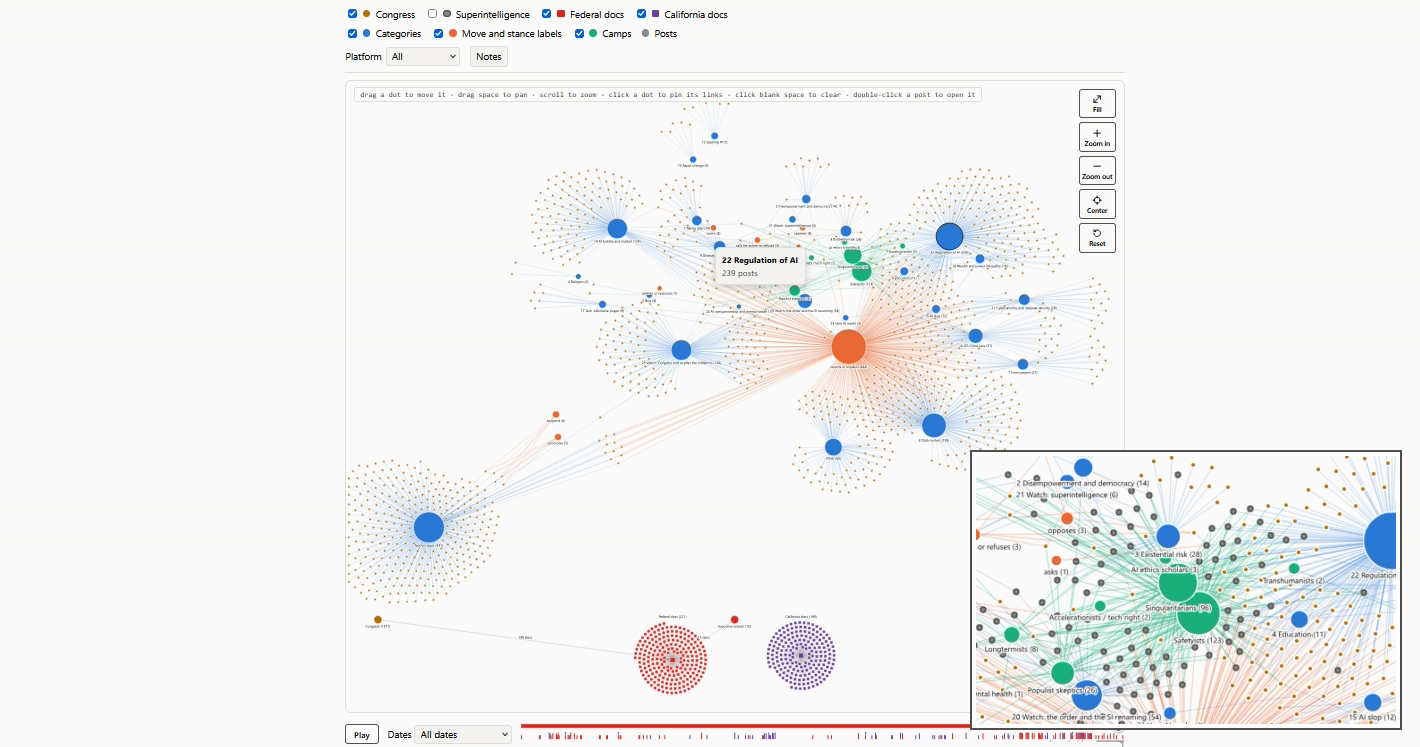
Follow updates of the debate and conversation over AI, job displacement, and policies using this visualization graph of social media posts and government documents from California and federal governments, including bills, committee notices and reports, floor remarks, executive orders, and proclamations.
An Expected Policy Divide
The record is built to show whether a split in governance emerges as a new Congress takes office:
- The executive branch: In my reading, a largely laissez-faire federal posture focused on national competitiveness, light-touch oversight, and high-level directives, such as the September 29, 2026 presidential executive order regarding agency terminology.
- The incoming Democratic Congress: The open question is whether it moves toward statutory guardrails, oversight of workplace displacement, and mandatory compliance standards.
- California: A proving ground between the two. State legislators have passed some worker-related AI bills and vetoed others, in the state that is home to many leading AI companies.
How to use this visualization graph
Use the graph to trace connections, the timeline to follow chronology day by day, and the table below to read every entry:
- Compare branches and jurisdictions: Toggle Federal docs (red) and California docs (purple) to compare what each produced. The brown dots are the Congress posts, and the executive branch has its own red node.
- Follow the “Superintelligence” posts: Check the Superintelligence toggle to add posts about superintelligence, many of them dated around the September 29, 2026 executive order directing federal agencies to say “super intelligence.” Posts about the order itself are in the topic “Watch: the order and the SI renaming.”
- Compare views: Camps and Move and stance labels group posts by the view they take.
(In the graph, drag a node to inspect connections, hold Ctrl or Cmd and scroll to zoom, click a dot to pin its links, and double-click a post to visit its source. Some posts have no link, to protect privacy.)
A note on scope
This timeline tracks timing, not causation—it does not assume online discussion directly causes legislative action, nor should the selected posts be read as representative of what Americans overall think.